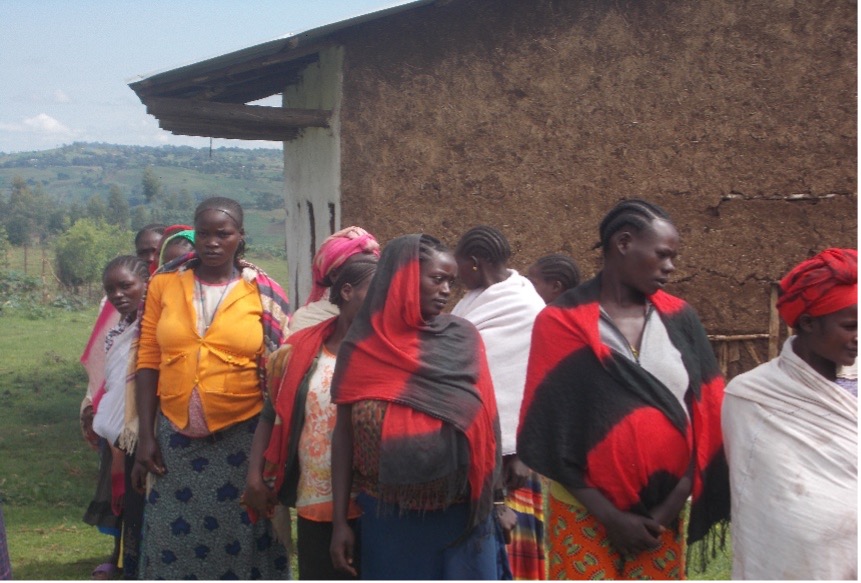
These interviews were conducted by Laury Bowman, J.D., Teklemariam Ergat, Ph.D., and Peter Van Arsdale, Ph.D., at 10 clinics and hospitals. Women arriving at one clinic are pictured above. All those interviewed were in their third trimester and awaiting delivery:
- The women interviewed represented these ethnic/tribal groups: Me’en, Bench, Amhara, Kafa, Oromo, and Dizi. Me’en (50%) were the most numerous, followed by Bench (20%).
- All but one of the women interviewed said that they would use this health facility again, for their next pregnancy, and would promote its use to others. The importance of the ante-natal services, the Maternal Waiting Areas (MWAs), and other services were explicitly noted by some respondents in this regard.
- All the women were healthy, although a few (15%) had recently experienced complications which were being dealt with professionally. A large number (70%) noted that, by coming to the facility, they would be able to avoid potential complications and protect the life of their newborn.
- The valuable roles played by health extension workers, many of whom had visited the homes of the respondents, were noted by 65% of the women. Additionally, the important role of “health festivals” were noted in two communities.
- In general, health extension workers and nurse midwives are the skilled professionals most widely engaged by these women. The roles of doctors and registered nurses were rarely mentioned.
- According to custom, all the women had consulted their husbands as to whether to engage the nearest clinic or hospital’s services for this pregnancy; 85% had received their husband’s support.
- A number of women (35%) commented on the lack of diversity in the food served at the facilities, including the MWAs. Maize porridge and cabbage, along with injera, are usually the primary foods served. A smaller number (30%) commented, negatively and in general, on the food served. However, it should be stressed that all but one said that their food (type, quantity) and/or nutritional status was adequate, when including food eaten at home. The idea of gardens, developed at MWAs and tended by the women there, was well received.
- A wide variety of crops are grown in this region, with maize being the most prominent. Others include teff (used to make injera), cabbage, taro, beans, bananas, sugar cane, oranges, papayas, avocados, and coffee. A general understanding of the “good food – good health” link by residents is apparent.
- No specific question in the protocol asked about MWAs. Among those women (40%) who independently chose to comment on the MWAs, it can be inferred that all saw them as important. However, depending on the facility, a number of these respondents noted a need for more beds, more blankets, more mattresses, more space, more food, more nursing clothing, and warmer floors. (At one location, the MWA was not in use. At another location, it was being improperly used by facility managers.)
- In various ways, and through a number of different comments, 90% of the women spoke favorably about one or more of the health services they were receiving. These included general ante-natal care, food, ultrasound, MWAs, health education, facility accessibility, and caring staff members.
- When asked what might constrain a woman or neighbor from visiting a clinic or hospital for delivery, a large number (80%) had suggestions. These included lack of transportation/distance, lack of family or husband’s support, lack of awareness, child care concerns, conflicting agricultural responsibilities, and cultural barriers (e.g., it being best to deliver at home where traditional methods are well understood; fear of being sterilized; privacy protection).
- Surprisingly, owing to water’s essential role, only three women mentioned a concern about its supply or quality. It can be inferred that water systems, while needing substantial upgrades or installations in most places, are nonetheless minimally serving patients’ needs.
- When asked about facility/service improvements they thought would be useful, a large number (80%) again had suggestions. In addition to those regarding food and MWAs (noted above), these included more medical supplies (including soap and sanitary items), functional ambulances, better trained kitchen staff, better timed services, incentives for women to come, consistent availability of ultrasound, consistent availability of electricity and light, and entertainment options in the MWAs.
